SHOULDER






Anterior dynamic stabilisation of the shoulder with Hill-Sachs notch filling (arthroscopy)
This procedure is indicated for patients with shoulder instability associated with a tear in the anterior labrum (Bankart lesion) and a bony notch in the humeral head known as a Hill-Sachs or Malgaigne lesion.
The operation is performed entirely arthroscopically through small incisions. It combines three complementary procedures that work together to restore shoulder stability.
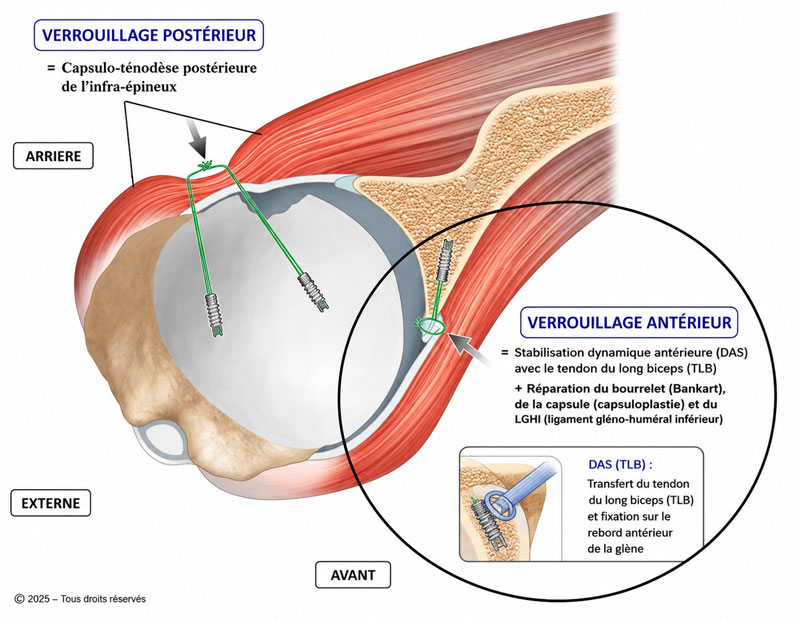
Anteriorly, the long biceps tendon is transferred and attached to the anterior rim of the glenoid cavity (anterior dynamic stabilisation or DAS). This tendon creates a genuine dynamic strut or strap effect in front of the joint, comparable to an active brake that counteracts displacement of the humeral head during high-risk movements. Simultaneous repair of the anterior labrum (Bankart repair) restores the normal anatomy of the glenoid cavity and reinforces this stabilising effect. Together, these two procedures provide both dynamic and static anterior locking of the shoulder.
Posteriorly, where the Hill-Sachs notch is significant, an infraspinatus capsulotenodesis (the ‘fill’ technique) is performed. The infraspinatus tendon and the posterior capsule are fixed within the bony notch, thereby eliminating impingement and preventing the tendon from catching on the anterior rim of the glenoid during extreme movements. This procedure provides complementary posterior locking.
The combination of these techniques thus creates a dual stabilisation mechanism: anterior stabilisation through the transfer of the long biceps tendon and Bankart repair, and posterior stabilisation through the filling of the notch by the infraspinatus. The aim is to reduce the risk of recurrent dislocation whilst preserving the bony anatomy of the shoulder and, in certain situations, avoiding a more invasive bony procedure such as the Latarjet procedure (coracoid impingement)
In summary: this arthroscopic procedure creates a genuine ‘double-lock’ system for the shoulder: an anterior lock provided by the long biceps tendon and repair of the labrum, and a posterior lock achieved by filling the Hill-Sachs notch with the infraspinatus muscle. This combination improves shoulder stability and reduces the risk of recurrent dislocations.