 SHOULDER






Latissimus dorsi transfer for reconstruction of an irreparable posterior rotator cuff tear
Latissimus dorsi tendon transfer is a procedure recommended for certain irreparable rotator cuff tears, with the aim of restoring shoulder elevation and, above all, external rotation.
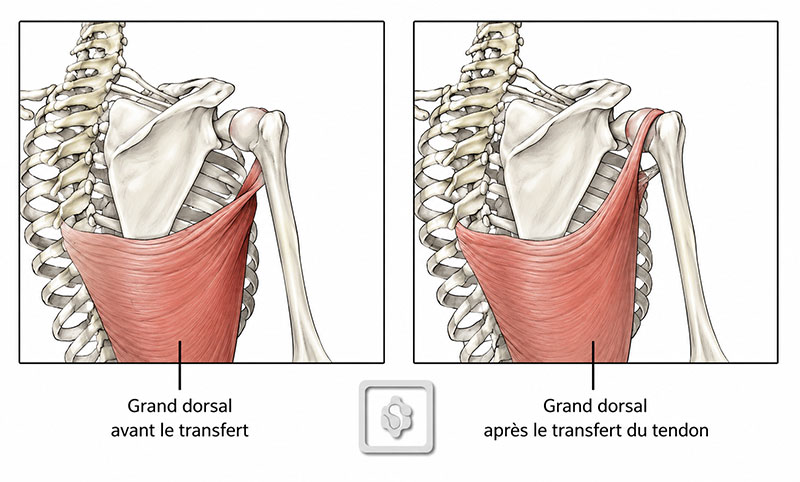
This surgery requires deep dissection close to the radial nerve, which, although rare, carries a risk of nerve injury or stretching that may lead to temporary or, in exceptional cases, long-lasting weakness in wrist and finger extension.
Nowadays, where clinically indicated, transfer of the inferior trapezius is often the preferred option. Its course is closer to that of the rotator cuff tendons; it better replicates their biomechanical function; it requires a dissection that poses less risk to the radial nerve; and it generally offers better restoration of external rotation. These reasons explain why, for many specialist teams, it has become the standard tendon transfer procedure for patients with an irreparable posterosuperior rotator cuff tear.