 WRIST
WRIST






Distal radius osteotomy
Distal radius osteotomy is a procedure designed to correct a deformity of the wrist, most commonly resulting from a fracture that has healed in a malposition (malunion). The bone is cut and then realigned to achieve the desired correction, before being stabilised with a plate and screws. A bone graft may sometimes be necessary to fill the gap created by the correction. The aim is to reduce pain, improve mobility, restore strength and limit the progression to osteoarthritis. The procedure is usually carried out on an outpatient basis or with a short hospital stay, followed by a period of immobilisation and then gradual rehabilitation.
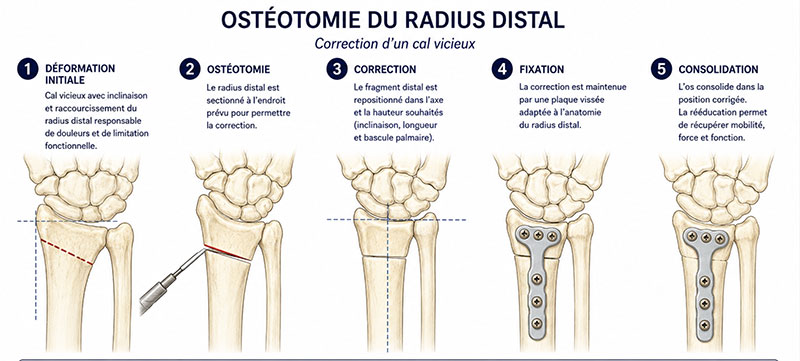
Post-operative care requires immobilisation followed by gradual rehabilitation over several months.
The clinical results are generally encouraging, but some studies have shown non-negligible rates of graft rupture or failure. For similar indications, reconstruction of the supraspinatus using an allograft of fascia lata attached to the scapula and humerus now appears to be a promising alternative, offering a more anatomical reconstruction and potentially greater reliability in the medium term.