 SHOULDER






Arthroscopic lower trapezius transfer – a biological solution for certain irreparable rotator cuff tears
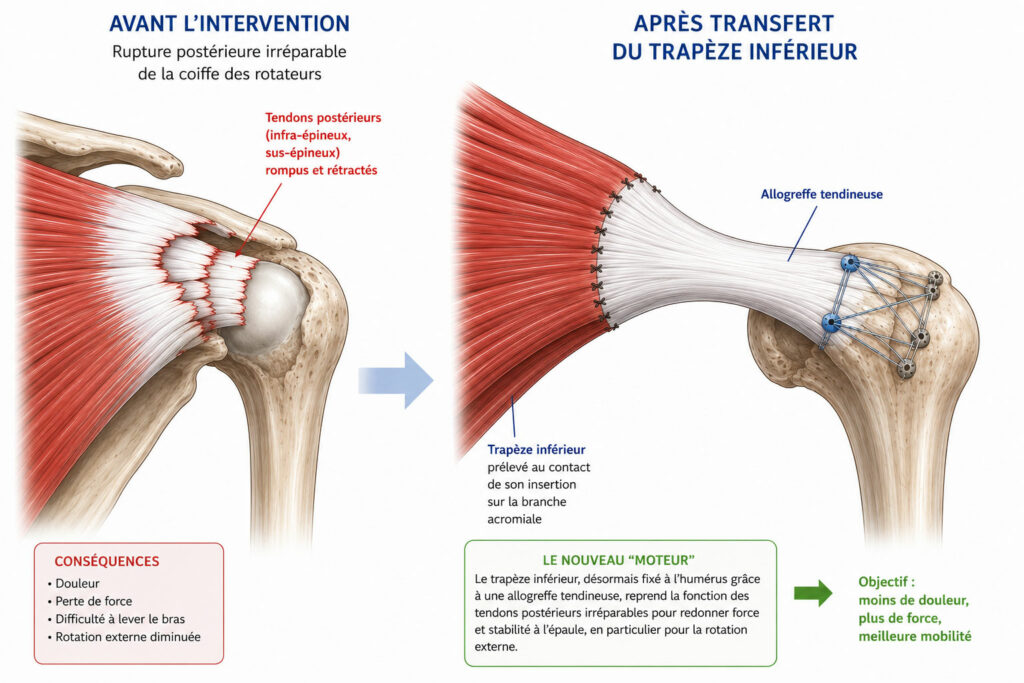
When a major tear in the posterior rotator cuff tendons (supraspinatus and infraspinatus) is long-standing and has retracted too far to be repaired directly, the shoulder may lose its strength and its ability to lift or rotate the arm outwards.
This situation often causes significant discomfort during everyday activities.
Exemple de résultat
Lower trapezius transfer is a surgical technique that involves using a healthy muscle from the back, the lower trapezius, to replace the function of tendons that can no longer be repaired. A tendon graft is used to attach this muscle to the humerus and restore a more natural range of motion in the shoulder.
The aim of this procedure is to reduce pain, improve mobility and, above all, restore the arm’s external rotation strength. Unlike a prosthesis, this reconstruction preserves the native joint and relies on the patient’s own muscles to restore a more physiological function.
This technique is primarily intended for active patients with a massive posterior rotator cuff tear, without advanced osteoarthritis of the shoulder. It offers an attractive alternative that often makes it possible to delay, or even avoid, the need for a shoulder prosthesis.
Recovery requires a period of immobilisation followed by specialised rehabilitation aimed at teaching the transferred muscle its new role. The results generally show a significant improvement in function and quality of life in carefully selected patients.