 ELBOW
ELBOW






Posterior interosseous nerve surgery at the elbow
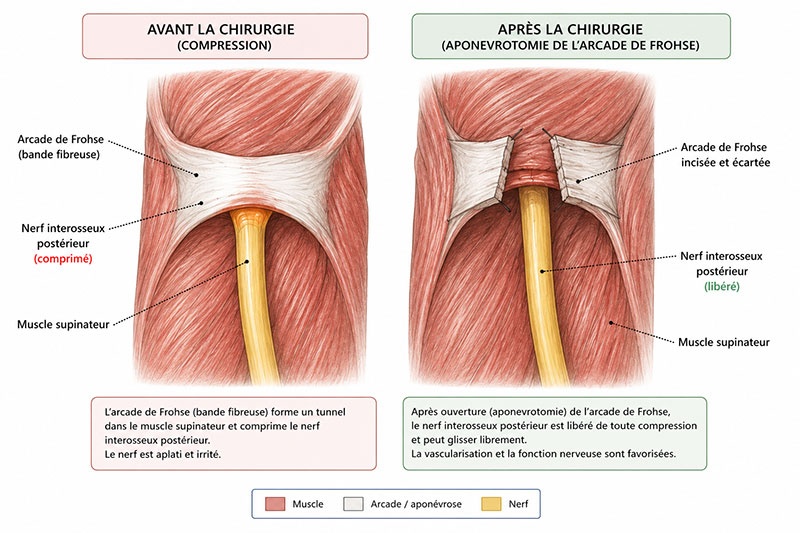
The posterior interosseous nerve is a motor branch of the radial nerve. It passes through a fibrous tunnel located within the supinator muscle at the elbow.
In some patients, this nerve may be compressed by a fibrous band known as Frohse’s arch, leading to:
– weakness or an inability to extend the fingers and thumb;
– functional impairment of the hand;
– sometimes pain in the forearm.
The aim of the procedure is to release the nerve by opening up this area of compression in order to promote the recovery of its function.
How is the operation carried out?
- The procedure is carried out under local or general anaesthesia.
- An incision is made on the outer side of the forearm, just below the elbow.
- The surgeon locates the posterior interosseous nerve.
- The fibrous arch of the supinator muscle is opened (aponeurotomy) to relieve the compression.
- The nerve is examined throughout the entire area of compression and then released from any constriction.
After the operation
- The arm is usually immobilised for a few days in a light bandage.
- Movement of the elbow and hand is regained quickly.
- Post-operative pain is usually moderate.
- Rehabilitation may be prescribed depending on the extent of the motor deficit.
Expected outcomes
Recovery depends mainly on the duration and severity of the compression prior to the procedure:
- where compression is recent, recovery may be rapid;
- in cases of long-standing paralysis, improvement may take several months;
- in some cases, recovery may remain incomplete despite satisfactory decompression.
Main risks
As with any surgical procedure, there is a small risk:
- of infection;
- haematoma;
- elbow stiffness;
- persistent or incomplete recovery from neurological deficits.
Summary
This procedure involves releasing the posterior interosseous nerve, which is compressed within the supinator muscle. The aim is to restore function to the extensor muscles of the fingers and thumb and to prevent the neurological deficit from worsening.