 SHOULDER – COMPLEX CASE






Composite reconstruction of the humerus using an inverted prosthesis
Certain complex shoulder conditions are associated with significant bone loss in the upper part of the humerus. This can occur, for example, following multiple surgical procedures, when a previous shoulder prosthesis has failed, or after certain complex fractures.
When the remaining bone stock is no longer sufficient to implant a prosthesis under optimal conditions, a composite reconstruction of the humerus combined with a reverse shoulder prosthesis may be recommended.
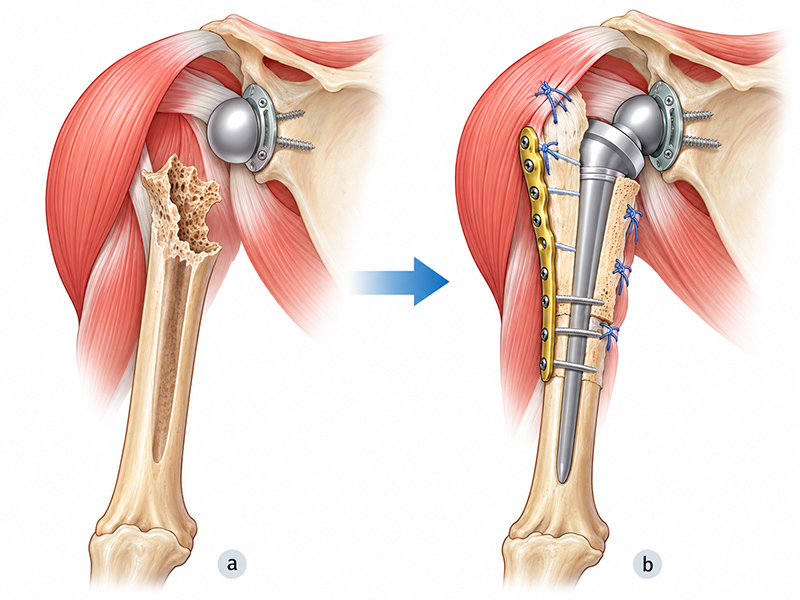
What does composite reconstruction involve?
This procedure combines two elements:
- an inverted shoulder prosthesis, designed to restore a stable and functional joint;
- a proximal humeral bone allograft*, sourced from a tissue bank, used to reconstruct the part of the humerus that has been destroyed or lost.
The prosthesis stem is implanted through the graft and then into the patient’s humerus. Together, these form what is known as a ‘composite allograft-prosthesis’ reconstruction.
The aim is therefore not only to replace the joint but also to reconstruct the architecture of the humerus.
Why use an allograft*?
Reconstruction using an allograft makes it possible to recreate a bone segment when the loss of bone substance is too extensive for a conventional prosthesis.
In particular, it can help to:
- restore the length of the humerus;
- improve the support for the prosthesis;
- restore satisfactory tension in the deltoid muscle;
- reconstruct certain muscle and tendon insertions;
- preserve or restore bone stock in particularly complex revision cases.
In what situations might this technique be recommended?
This surgery is primarily considered in cases of significant humeral bone loss, for example:
- following the failure or loosening of a previous shoulder prosthesis;
- following multiple shoulder operations resulting in the destruction of the bone stock;
- in certain cases following complex fractures of the proximal humerus;
- more rarely, following extensive bone resection.
Every case is different. The choice between composite reconstruction, a long revision stem, metal reconstruction or other solutions depends, in particular, on the extent of the bone loss, the quality of the remaining humerus and the condition of the muscles and tendons around the shoulder.
A complex reconstructive procedure
Composite humeral reconstruction is a much more complex surgical procedure than a primary reverse shoulder arthroplasty.
Careful pre-operative planning is required, based on X-rays and, in most cases, a CT scan.
During the operation, several stages must be co-ordinated: removal of any previous implants, preparation of the remaining humerus, preparation of the graft, implantation of the reverse prosthesis, fixation of the graft to the humerus and soft tissue reconstruction.
The aim is to achieve both stable mechanical fixation of the prosthesis and gradual integration of the graft into the patient’s bone.
After the procedure
Recovery generally takes longer than with a standard reverse prosthesis.
Protecting the bone reconstruction is essential during the first few weeks. Rehabilitation is therefore tailored to the strength of the reconstruction, the quality of the tissues and the procedures carried out during the operation.
The union between the graft and the humerus is monitored regularly via X-rays.
The functional outcome depends on many factors: the initial condition of the shoulder, the number of previous operations, muscle quality, neurological status and the extent of bone loss.
A strategy tailored to each case of bone loss
Significant bone loss in the proximal humerus is one of the most challenging situations in shoulder prosthetic surgery.
Composite reconstruction using a reverse prosthesis is one of the solutions that allows for the simultaneous reconstruction of the bone, the architecture of the humerus and the shoulder joint when conventional techniques are no longer sufficient.
What are the specific risks?
In addition to the usual risks associated with a shoulder prosthesis, this complex reconstruction carries particular risks, including:
- difficulty in the graft fusing with the humerus;
- resorption or fracture of the graft;
- infection;
- dislocation or instability of the prosthesis;
- fracture of the humerus;
- neurological damage;
- loosening or mechanical complications with the implant;
- the need for further surgery.
The procedure is therefore indicated only in situations where bone loss warrants this reconstruction.